· Lukasz Lancucki · Guides · 3 min read
Mapping Technology Readiness Level (TRL) Through Grant Funding Signals
Evaluate your Technology Readiness Level (TRL) across software, medtech, biotech, hardware, and industrial processes using public EU grant signals and the official BRIDGE2HE diagnostic framework.
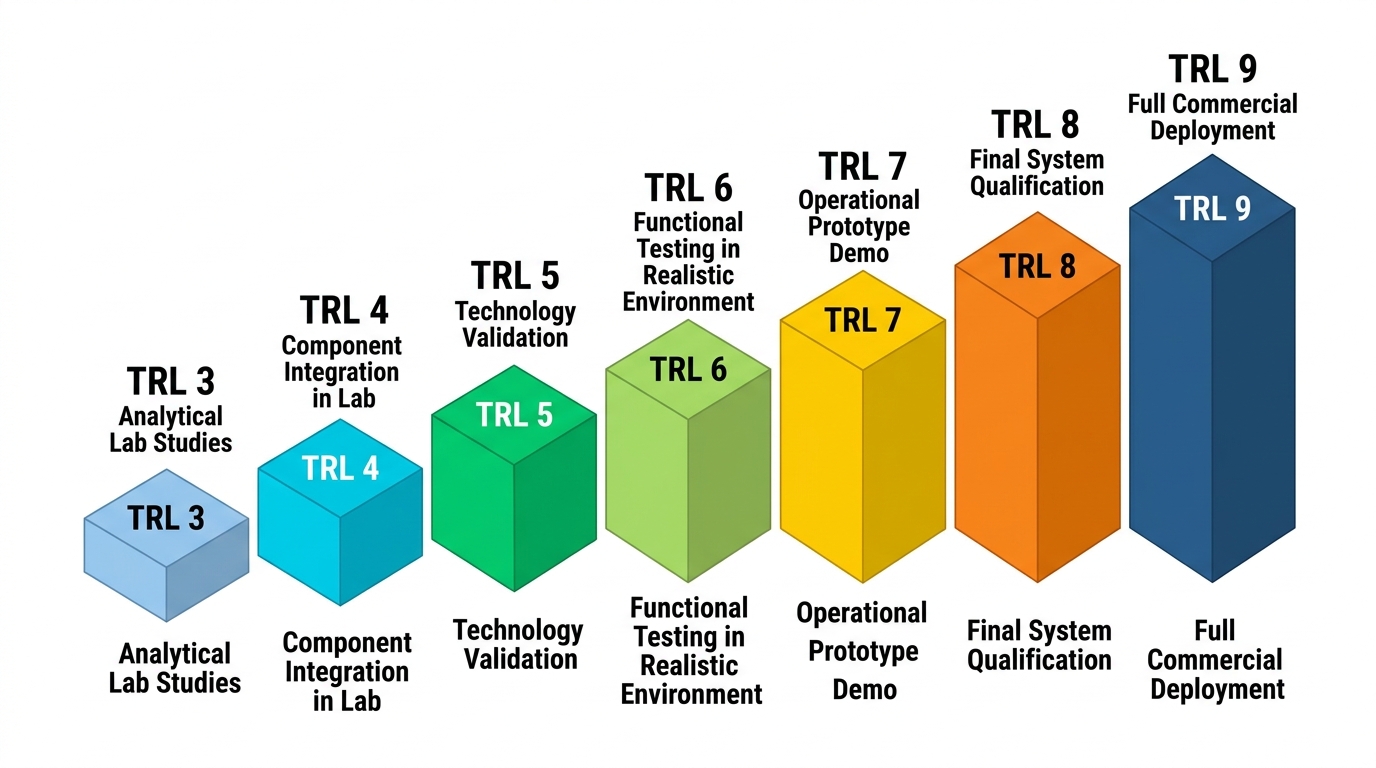
Applying for European research grants requires precise positioning alongside your broader non-dilutive funding strategy. Public R&D grant databases contain a continuous timeline tracking technology progression from basic lab research to commercial deployment. Evaluating how projects transition across EU funding framework tiers reveals exact Technology Readiness Levels (TRL) and commercialization timing long before product launches or equity funding rounds occur.
What is the Technology Readiness Level (TRL) Scale in EU Funding?
Originally introduced by NASA and integrated into European Commission framework programs during Horizon 2020, the TRL scale measures technology maturity on a 1-to-9 scale:
- TRL 1: Basic principles observed.
- TRL 2: Technology concept formulated.
- TRL 3: Experimental proof of concept.
- TRL 4: Technology validated in a laboratory environment.
- TRL 5: Technology validated in a relevant or industrially relevant environment.
- TRL 6: Technology demonstrated in a relevant or industrially relevant environment.
- TRL 7: System prototype demonstration in an operational environment.
- TRL 8: System complete and qualified.
- TRL 9: Actual system proven in an operational environment.
The European Commission aligns specific funding instruments directly to these TRL entry and exit points:
- European Research Council (ERC) Actions: Target blue-sky research, with ERC Proof-of-Concept instruments bringing projects to TRL 3 or 4.
- Horizon Europe Research and Innovation Actions (RIA): Cover projects starting at TRL 2–3 and reaching TRL 5–6.
- Horizon Europe Innovation Actions (IA): Cover projects starting at TRL 4–5 and reaching TRL 6–8.
- EIC Pathfinder: Funds early-stage radical technologies moving from TRL 1–2 to TRL 3–4.
- EIC Transition: Funds validation and demonstration moving technologies from TRL 3–4 to TRL 5–6.
- EIC Accelerator: Directs capital to startups and SMEs scaling from TRL 5/6 through TRL 9.
How Do You Determine Your Solution’s Exact TRL?
Assigning a self-declared TRL requires answering three diagnostic questions defined by the BRIDGE2HE framework:
- What type of solution are you developing? (Manufactured product, industrial process, software, medical device, or drug).
- What is missing from your innovation to be in its final form? (Assesses whether you are testing a partial prototype or a complete, manufacturable product).
- How controlled are the conditions in which you operate? (Controlled lab testing caps maturity at TRL 5–6, whereas unconstrained real-world deployment indicates TRL 7+).
Sector-Specific TRL Diagnostic Matrix
| Solution Type | TRL 4 (Lab Validation) | TRL 6 (Operational Demo) | TRL 8 (Market Ready) |
|---|---|---|---|
| Software / SaaS | Alpha version tested internally by the development team. | Beta version tested by selected end-users under controlled conditions. | Stable version available for the market. |
| Manufactured Product | Basic components integrated in lab; durability unproven. | Functional version working in a realistic environment. | Final product operating in full expected conditions. |
| Industrial Process | Process components validated individually at lab scale. | Pilot plant unit operating at ~1/10th commercial scale. | Demonstration plant constructed (~1/10th scale) operated continuously. |
| Medical Device | Safety and concept proven in-vitro or non-GMP conditions. | Prototype demonstrated in operational clinical environment. | Pre-market application submitted and approved. |
| Therapeutic Drug | Safety and proof of concept demonstrated in animal models. | Phase 1 clinical trials completed to proceed with Phase 2. | Phase 3 clinical trials completed; regulatory approval granted. |
Tracking TRL Progression in Public CORDIS Records
When monitoring competitors or evaluating potential partners in public CORDIS records, three indicators show that a technology is moving toward commercial readiness:
- Framework Instrument Shifts: An organization moving from Research and Innovation Actions (RIA) to Innovation Actions (IA) or EIC Transition projects signals a transition from lab validation (TRL 4) to real-world pilot testing (TRL 7).
- Consortium Composition: As projects pass TRL 5, academic research institutions shift leadership to industrial manufacturers, utilities, and commercial end-users.
- Industrial Co-Financing: Industrial partners committing co-financing and engineering time indicate active technology validation for potential supply chain integration or M&A.
Audit Your Project’s TRL & Grant Eligibility
Applying to a call above or below your actual TRL results in immediate proposal disqualification.
Upload your pitch deck or project documentation to Grants8. Our matching engine parses your technical documents, identifies your solution’s current TRL, and matches you with open non-dilutive funding opportunities.